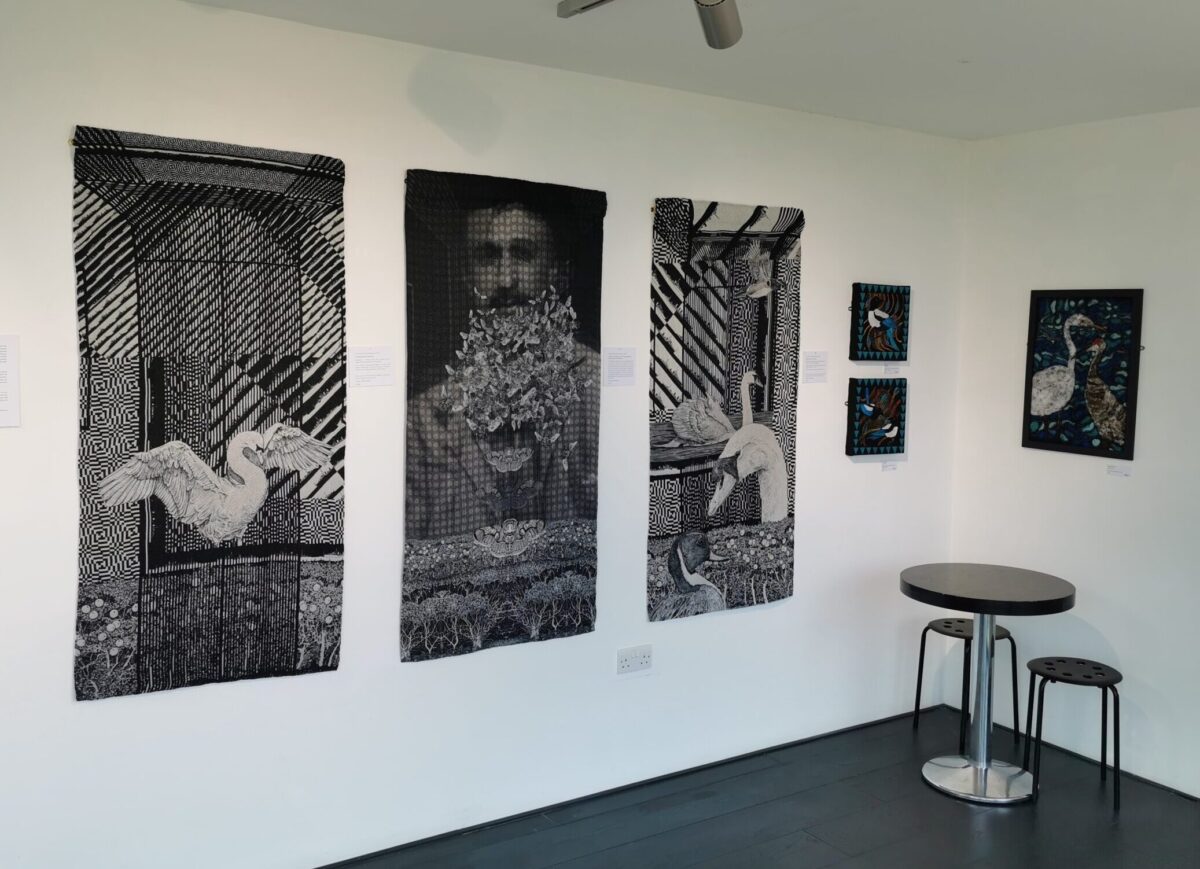
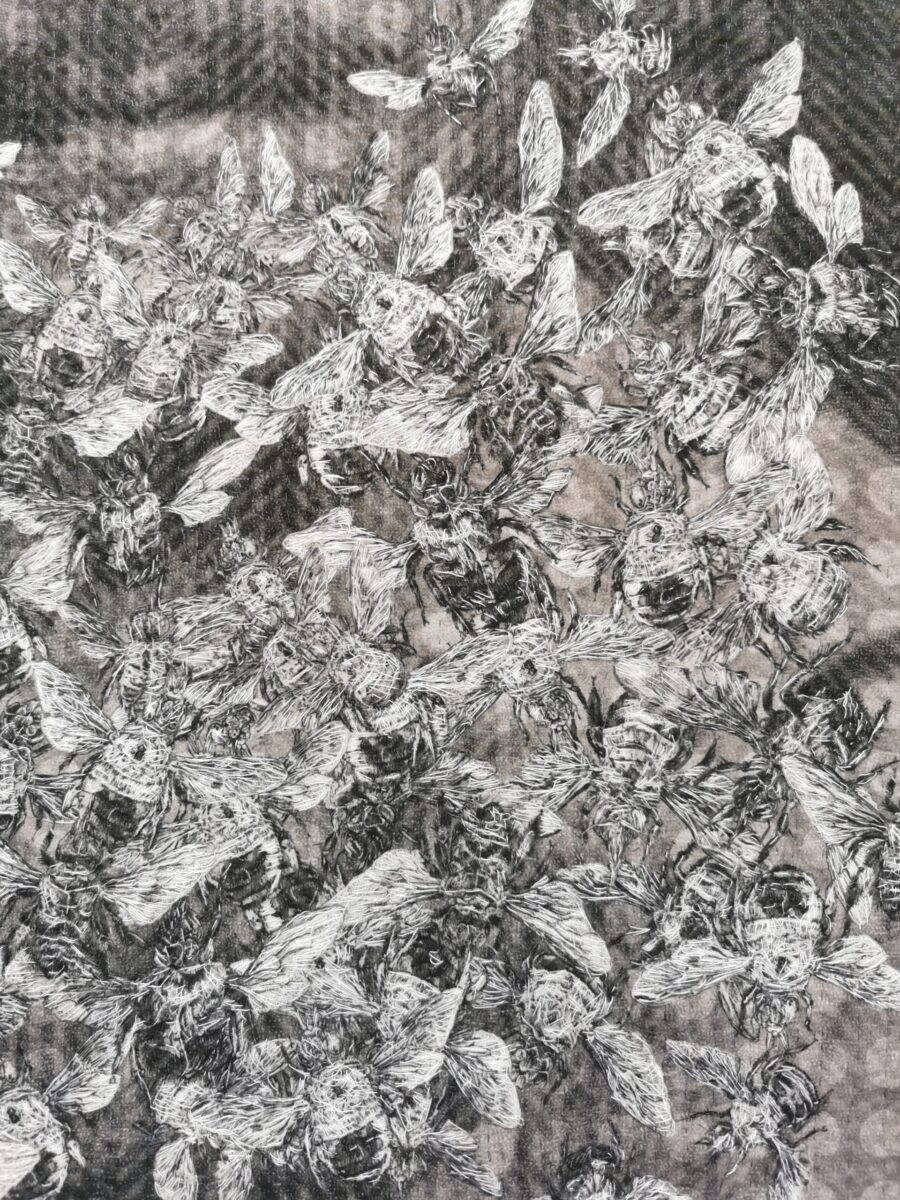
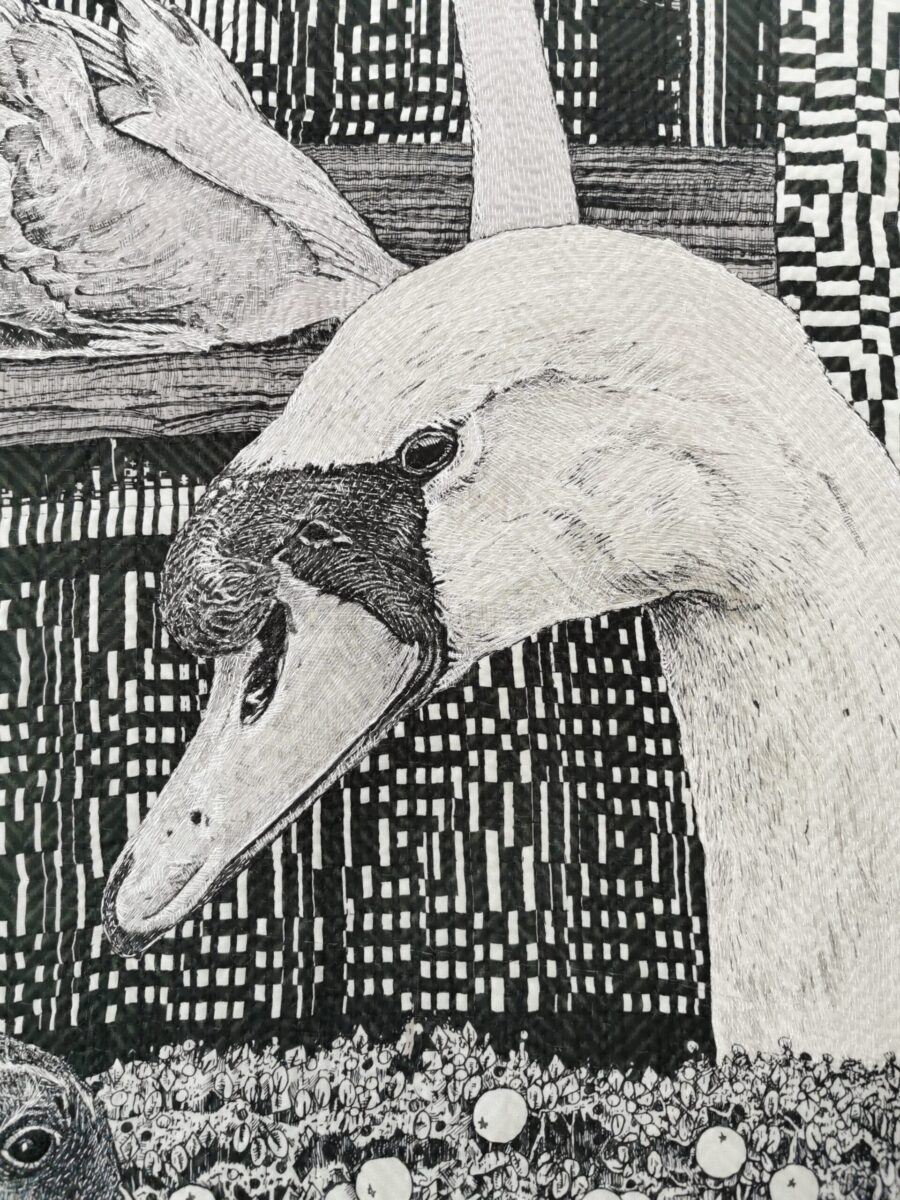
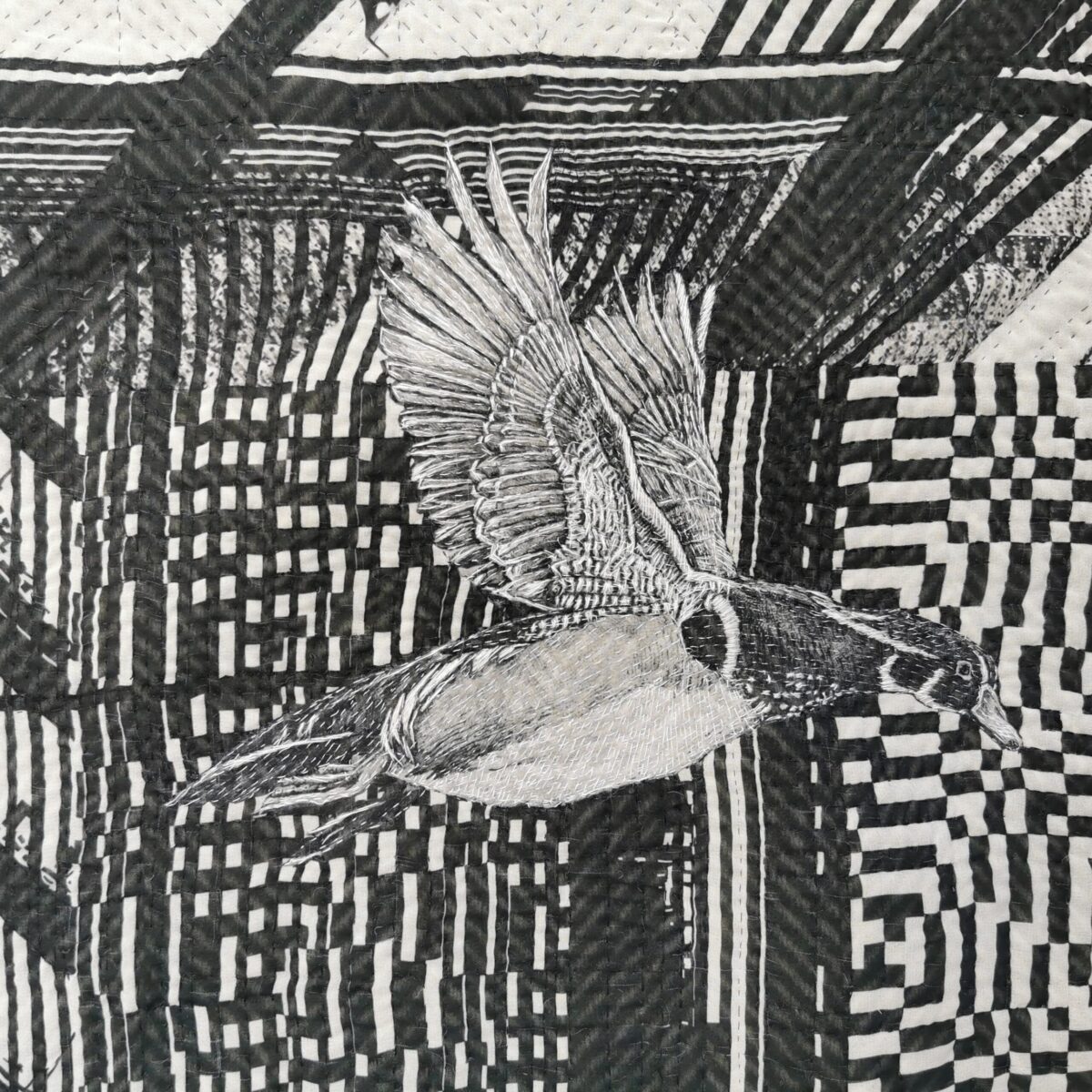
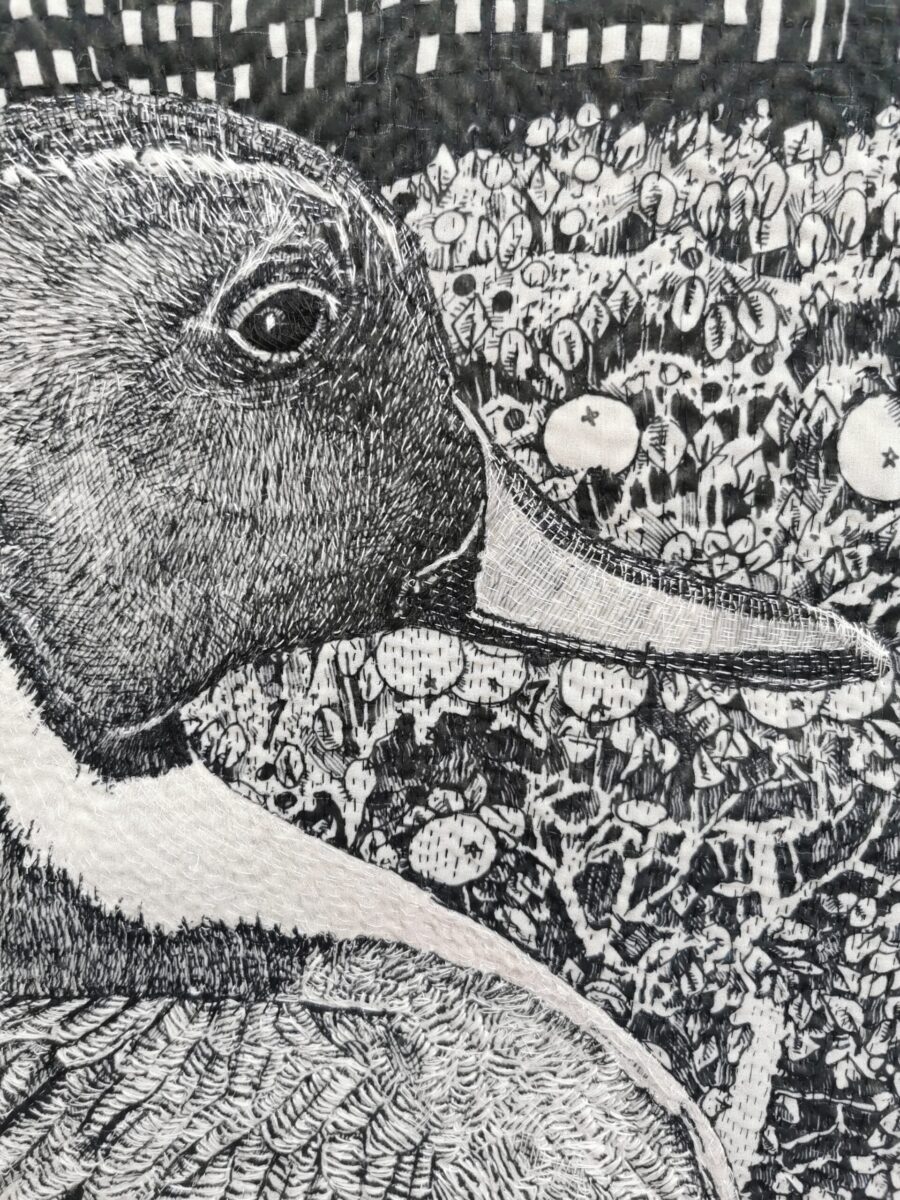
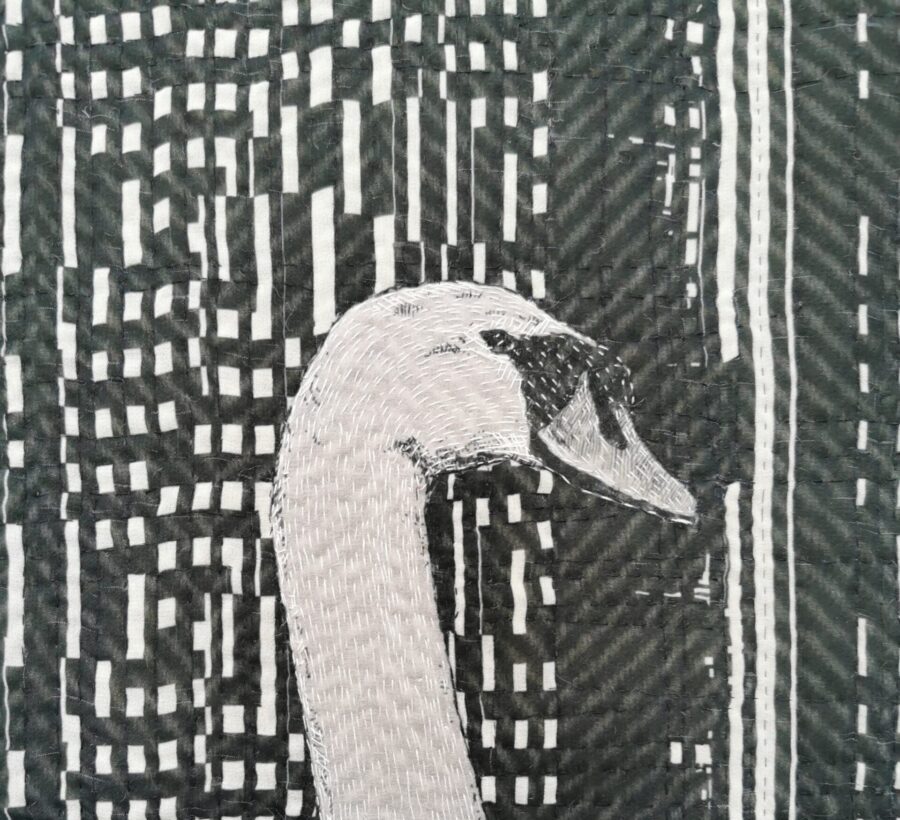
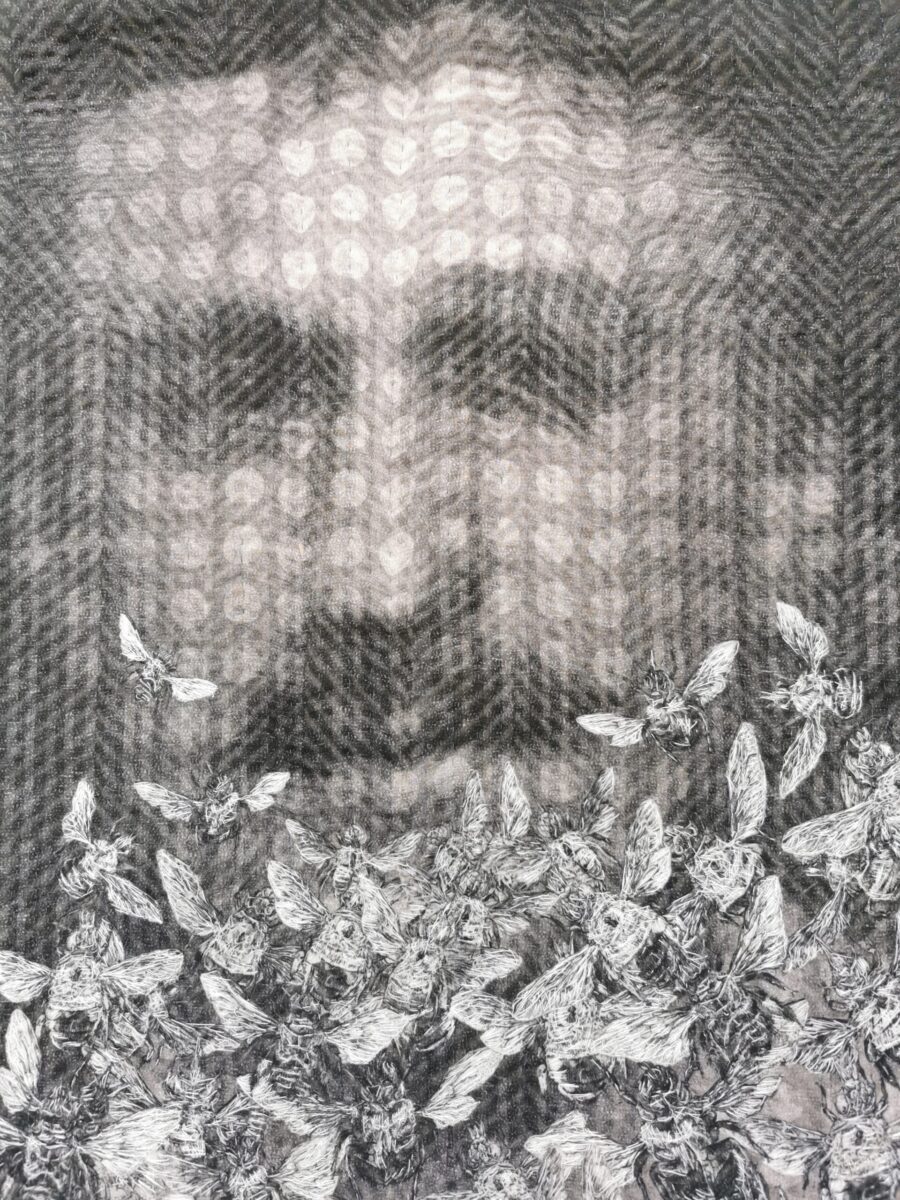
Site specific triptych for 78 Derogate, Northampton as part of an exhibition with Visualise Textile group 2025
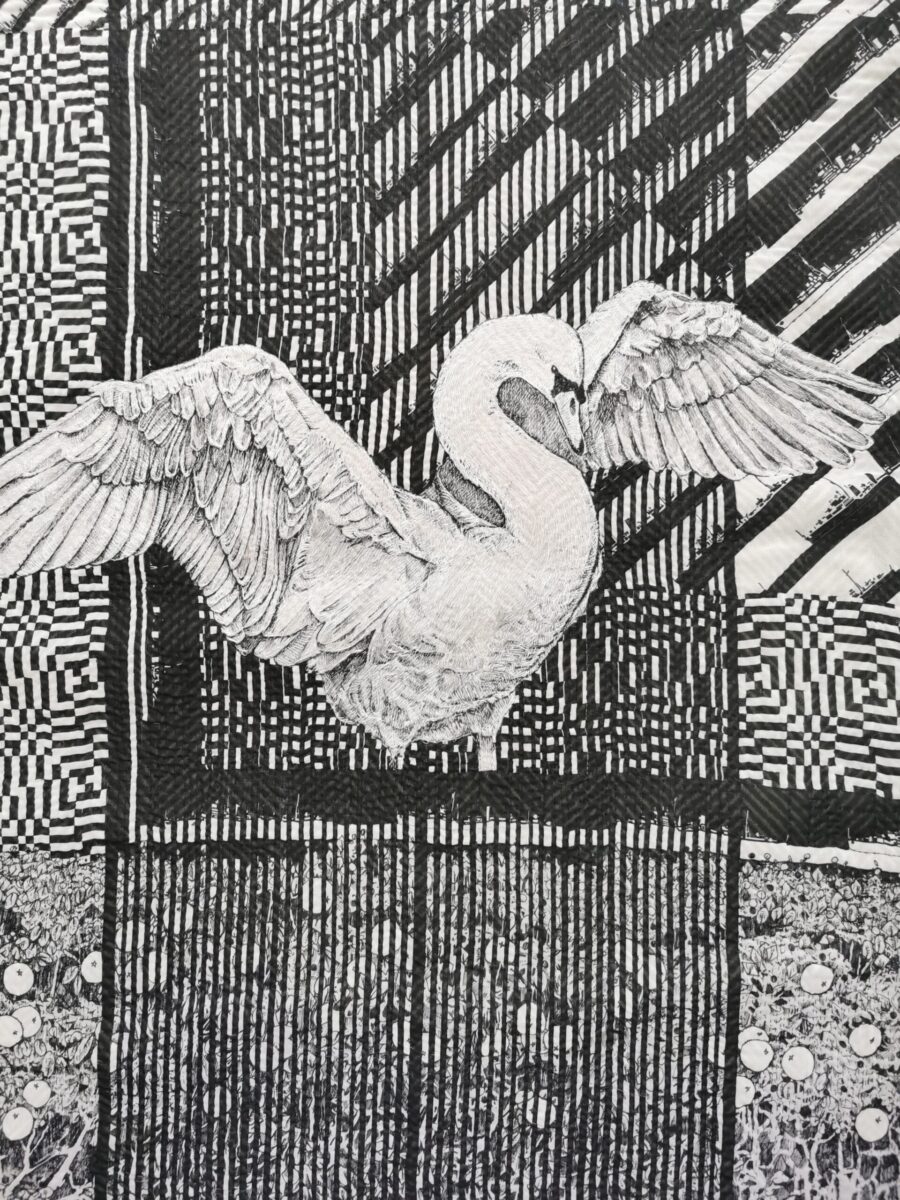
(80 x 150 cm. Digital print on Polyester Georgette, hand stitched onto a pure wool ground with cotton and metallic threads.)
The diversity of incredible work produced by Mackintosh was a profound childhood inspiration. From the refined beauty of his early architectural studies, through the economy of his draughtsmanship with the stylised trees, the boldness of geometric design work to the richness of his later watercolours were all starting points for my own creative journey. As I became increasingly interested in stitch my appreciation of the ‘Four’ and in particular Margaret Macdonald blossomed.
Perhaps her most famous work is a triptych in gesso; ‘The Seven Princesses’ (1906) commissioned by Fritz Waerndorfer for the music room is his Vienna home. The mystery that surrounds Mackintosh’s companion piece, ’The Arrival of Prince Marcellus’ only heightened my interest and triggered the research for this work. Maurice Maeterlinck (1862-1948) was a Belgian Nobel Prize winning symbolist poet, philosopher and playwright. His original text for the ‘Seven Princesses’ was in French and I have relied on the translation by Richard Hovey. In this retelling of ‘sleeping beauty’ as an aesthetic piece with little dialogue I think he captures the unsettling and eerie atmosphere of a stagnant land where time has stood still awaiting the return of the Prince for the Princess Ursula and her six cousins.
The strong linear composition of figures in medieval-esque costume and stylised forms rely on a static, geometric aesthetic that is about a pose rather than movement. In Macdonald’s work this is softened by her medium. The chalkiness of the gesso is offset with jewel like qualities of inlay of mother of pearl, glass beads and tin foil.
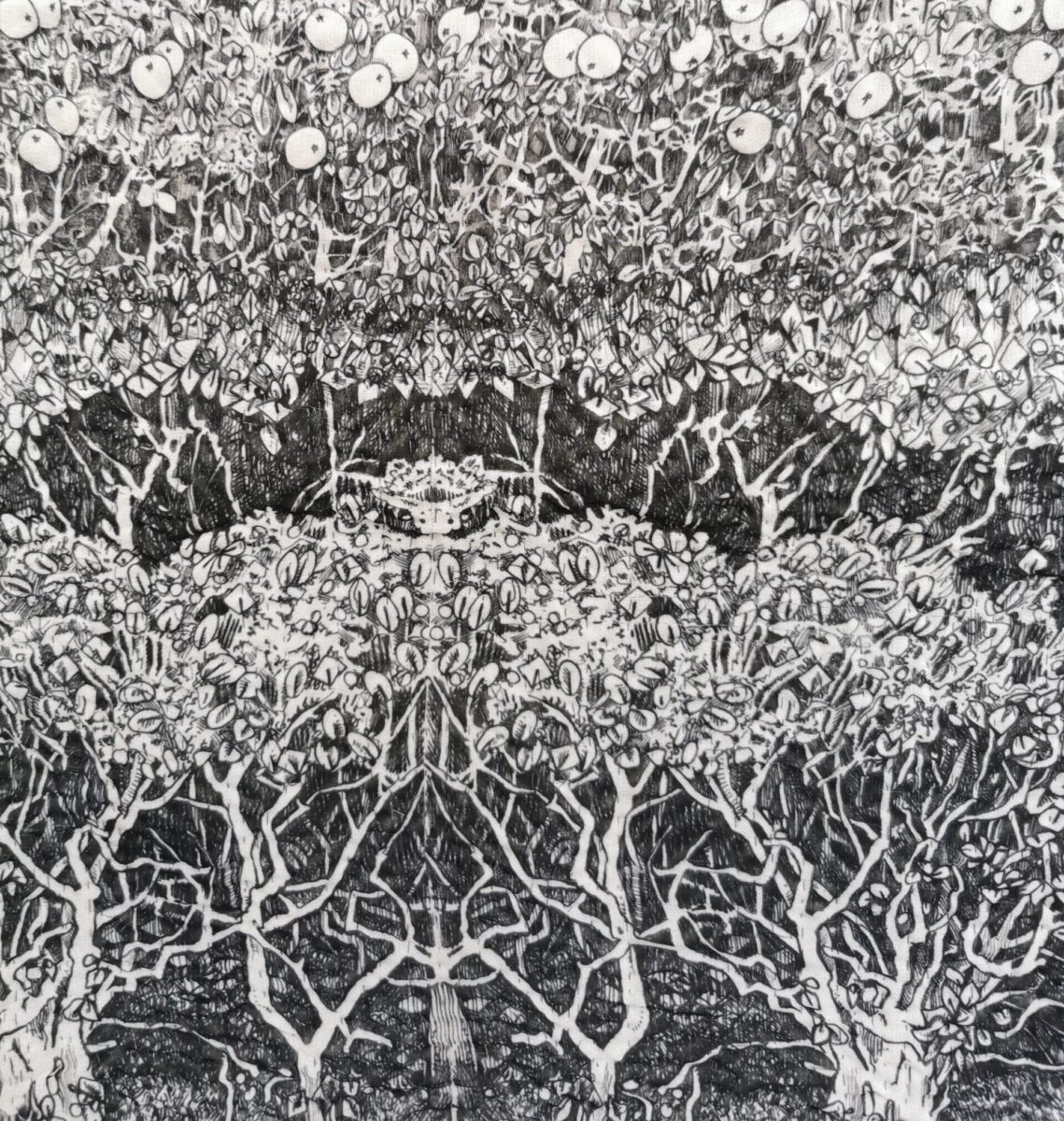
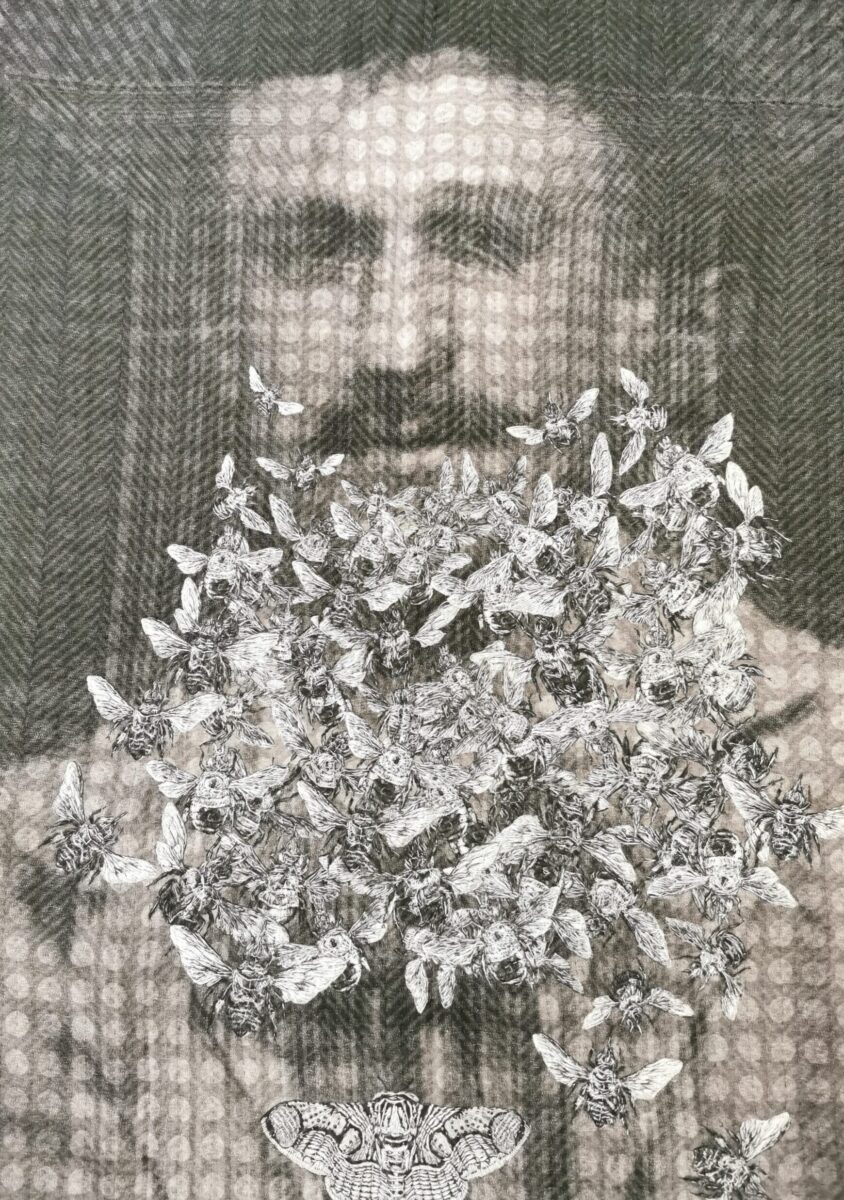
My work often begins with a text. I avoid a direct illustrative response but rather to reflect on the context and visual elements that are present. Drawing forms the spine of my work and from this digital manipulation and printing allow me to colour cloth with my designs. After this stage hundreds of hours of simple hand stitching highlight the imagery and fuse the layers of cloth together. The meditative nature of stabbing fabric over and over again means that results are never quick and the process itself imbues the work with another dimension.
I deliberately chose to focus on the limitations of monochrome and knew that the stitching would distort and soften the graphic nature of the print as it fuses together the wool fibres with the polyester surface, like Macdonald I have used metallic elements in a subtle way to heighten surface interest. An appreciation of traditional craftsmanship seen through a contemporary lens is a mutual love that I share with the Glasgow School of Art.
As a location I feel Number 78 Derogate was the chief inspiration to this work, in a way that I find the unique character of the play was obviously the set design. Without that interior the actors could never convey the disconcerting quietness and impending sense of doom. There is a drama in the interior that must have been mesmerising in performances.
‘to the right and left of the doors large windows whose panes reach down to the level of the tiles.’
For me the most impressive design feature of the masterpiece that is the Northampton house is the guest bedroom with its dazzling, stripey decorative scheme. I can only imagine the dreams anyone would have sleeping beneath those lines. I have echoed this effect with strong verticals that I feel form the gates to this imaginary kingdom. The land is overgrown with a stylised forest that leans into the architectural plans favoured by Mackintosh and creates a tension with the more realistic elements in a way that his later still lives play with dynamic pattern against botanical accuracy. Returning to Maeterlinck’s symbolic and minimal text I wanted to reflect a powerful atmosphere that he captures so well in this tragedy. The play leaves more questions than answers. We are not told what has kept the Prince away for so long. Whether it be battles in distant lands, exploration or trade, he and his fleet of sailors are obviously disturbed by encountering the overgrown chateau that has lost all traces of the magnificence they remember. We are not told what has caused this sickness with the seven beautiful princesses. Are they simply wasting away, or is it through sickness or enchantment. Haunted by the ‘sleeping’ seven princesses the elderly King and Queen are in despair, their ultimately futile hope of salvation is focused on the returning Prince. As a protagonist Marcellus is the ultimate wet blanket. He may have a physical prowess that has served him well in battle but he is totally unequipped with how to react to the ghostly stillness of his promised bride.
‘At the contact of the flesh he rises suddenly, with a long and sweeping look off terror’
In our post pandemic society it reminds me of our fear of intimacy and infection from the unseen and unexplained.
Unlike a Disney adaptation there are no dragons to slay and he recoils at the mere touch of her hand so there is zero chance of love’s true kiss awakening her. Our only hope is that nature will assert itself and the birds will flourish now man has left.