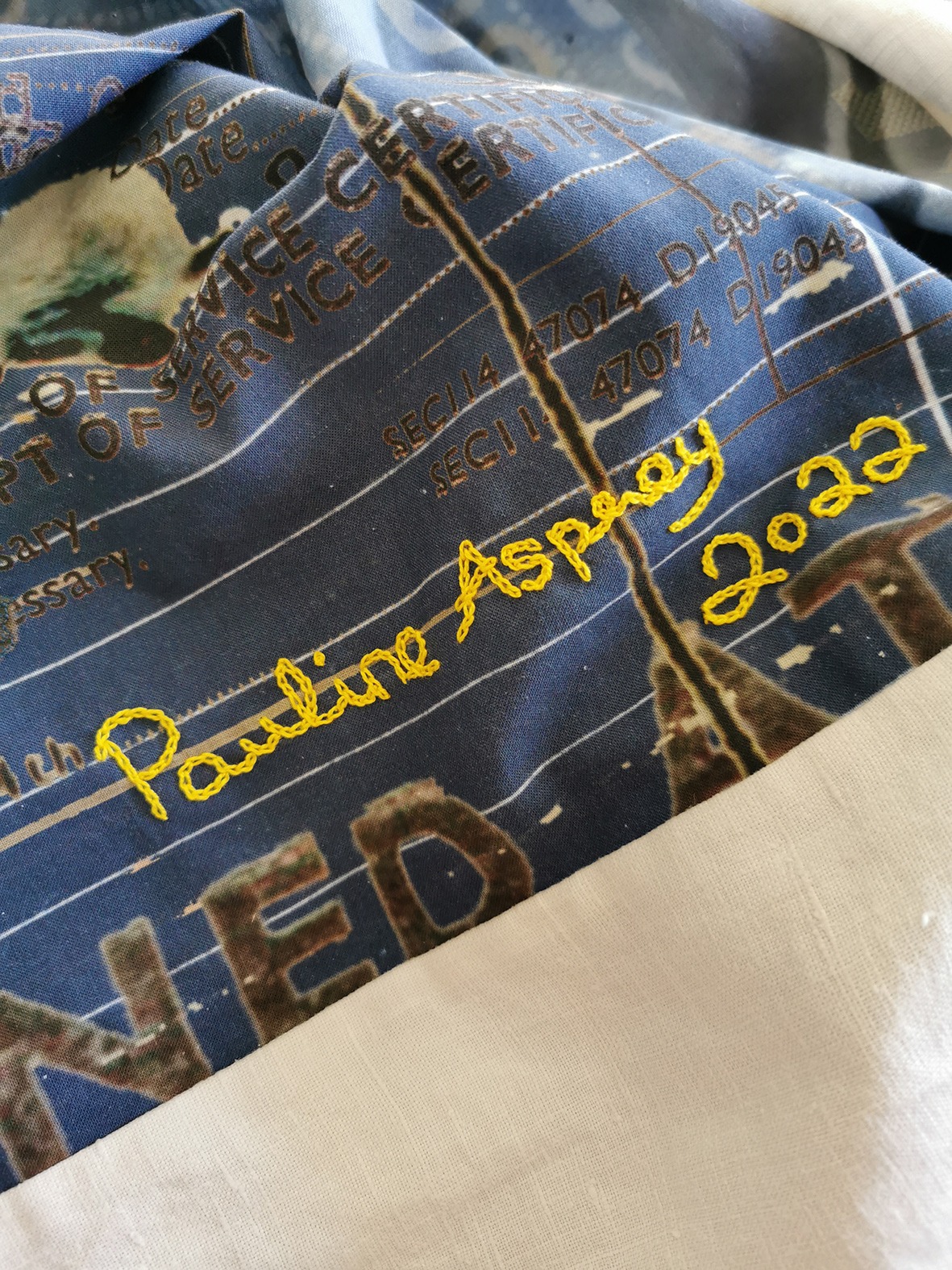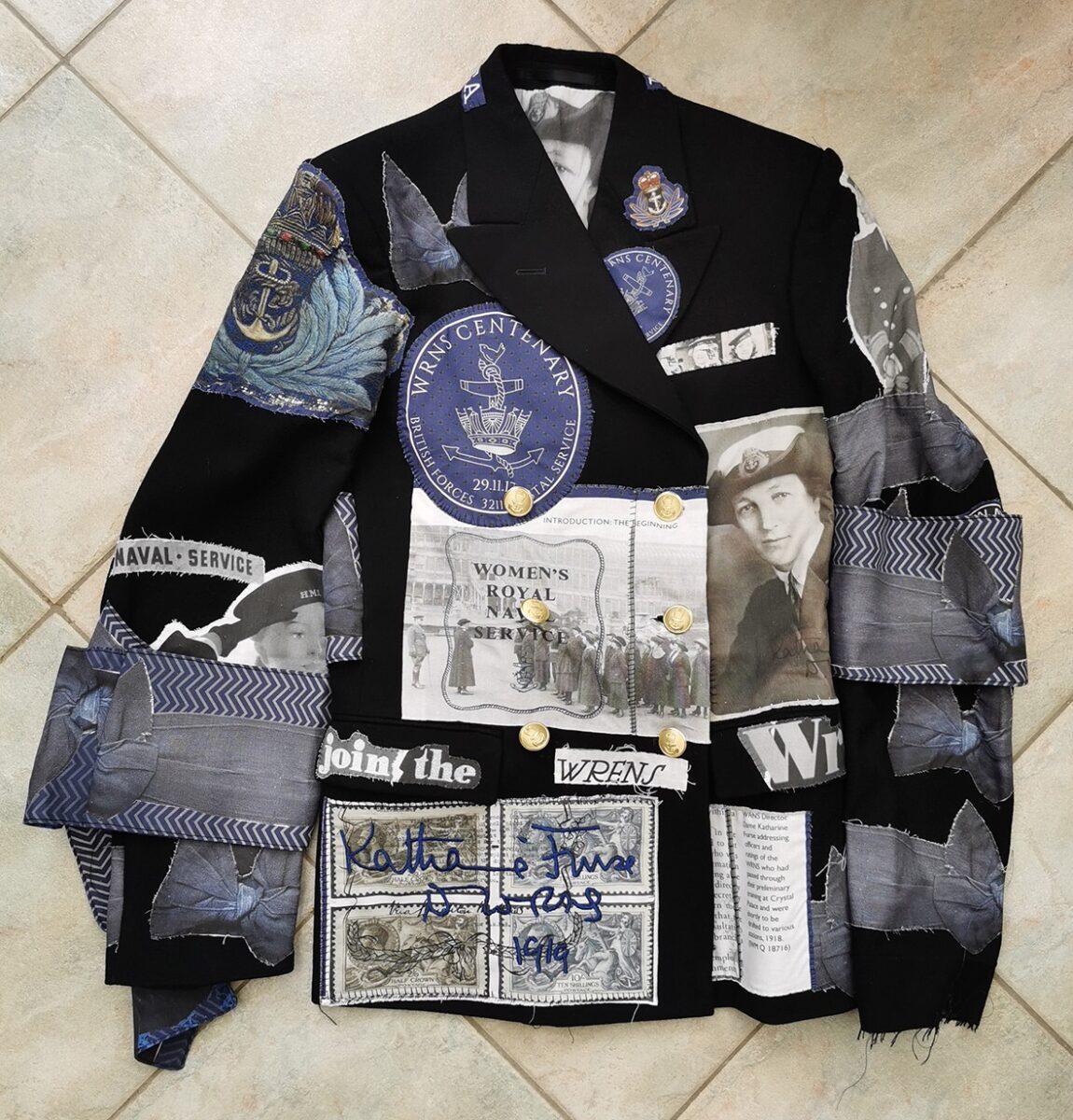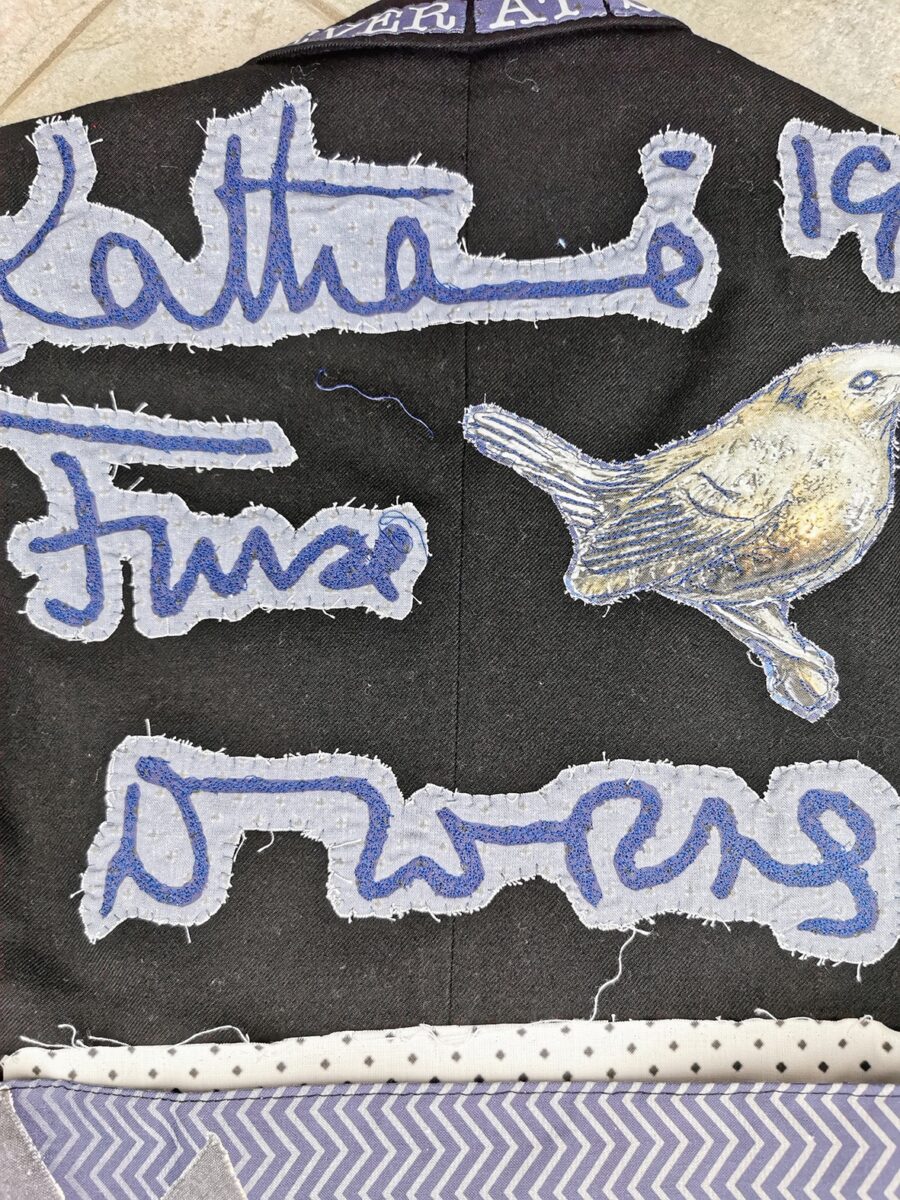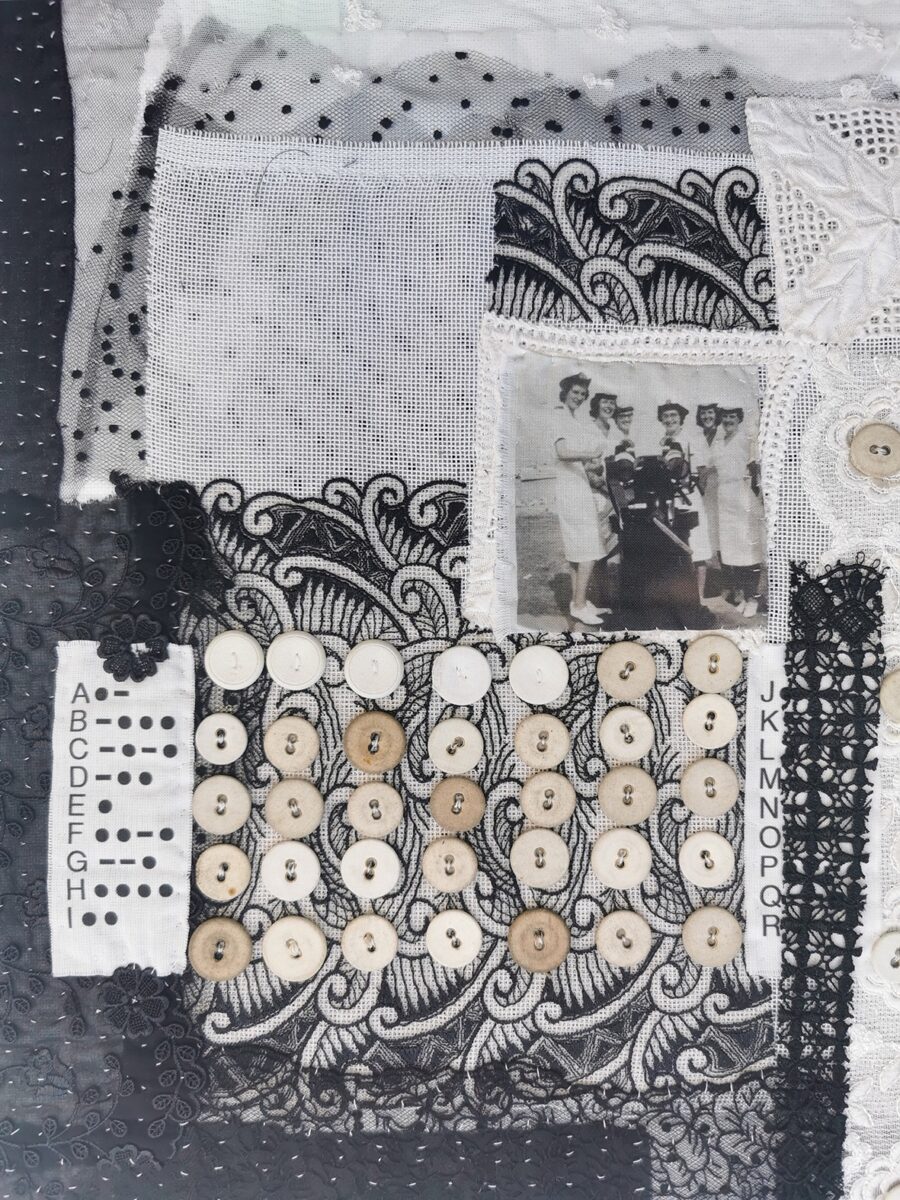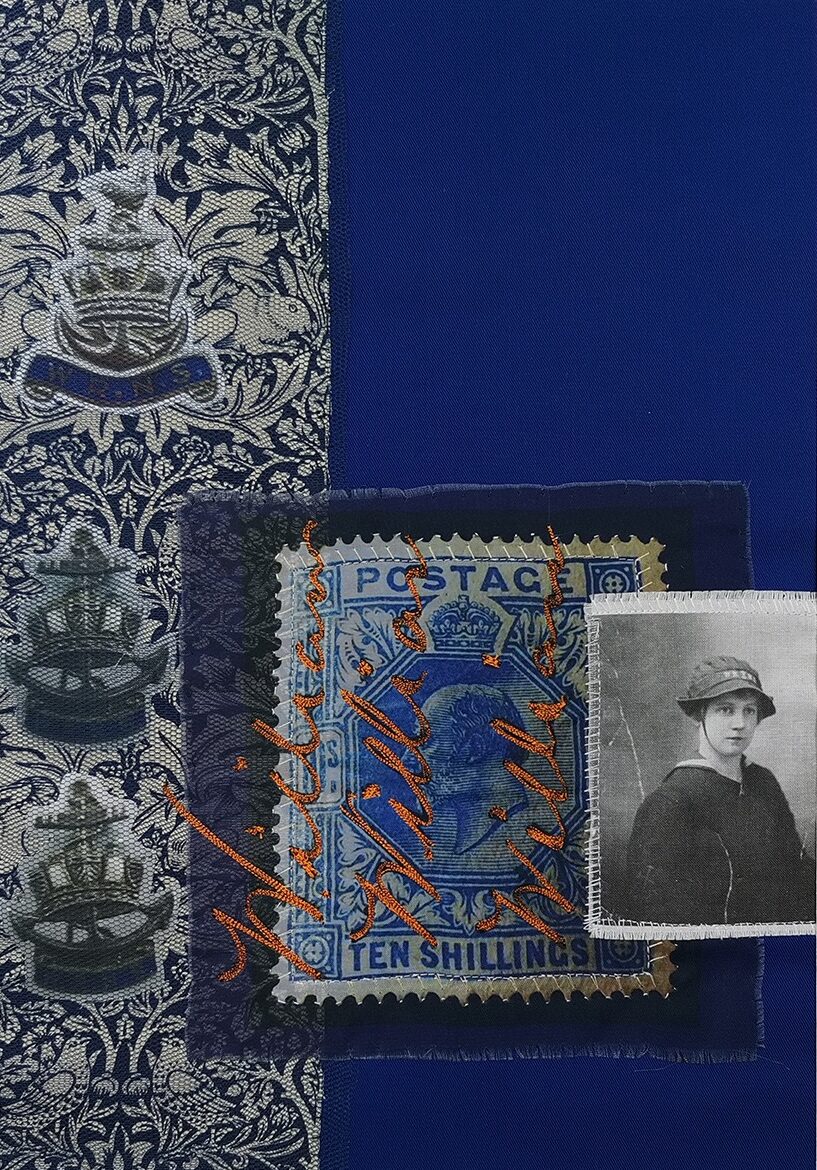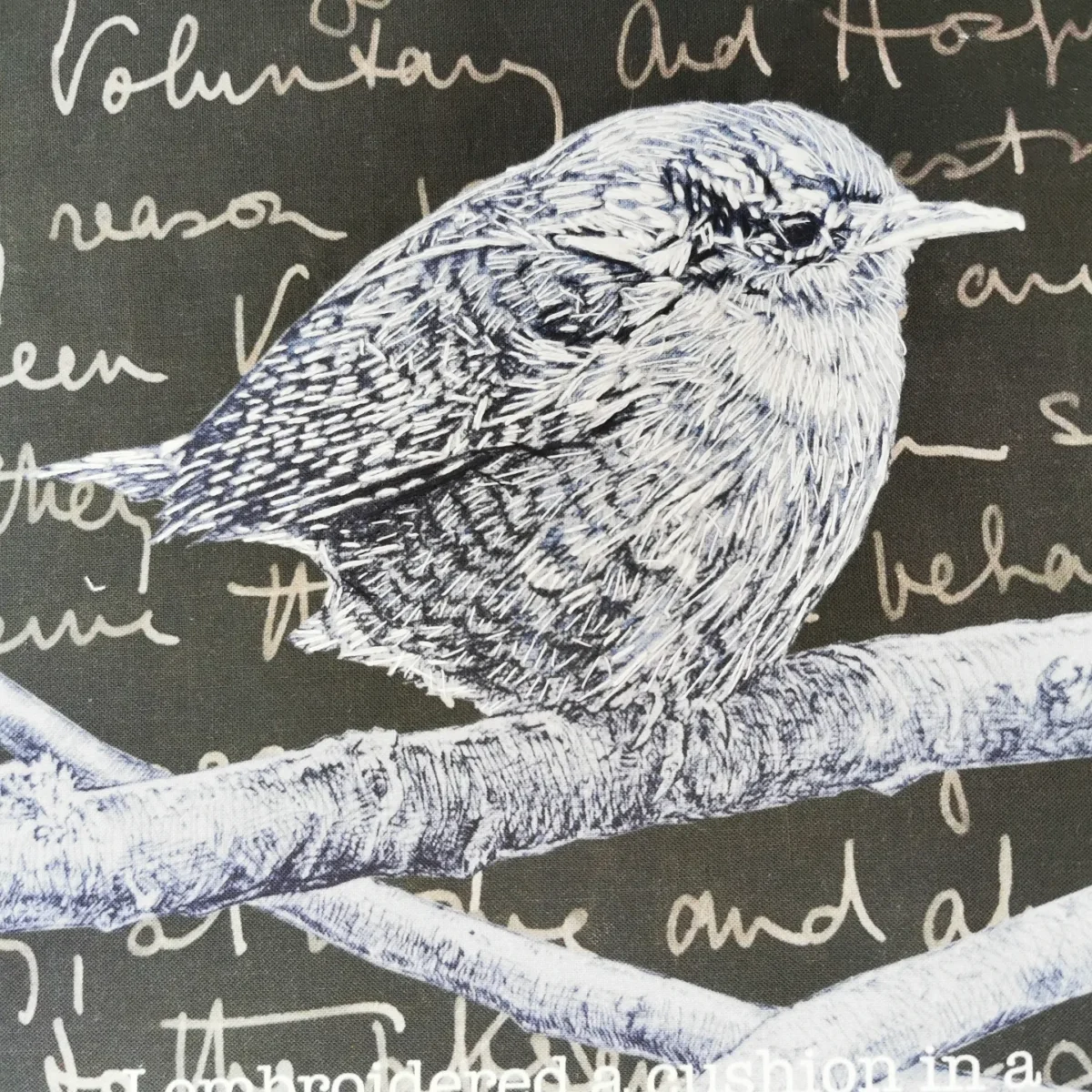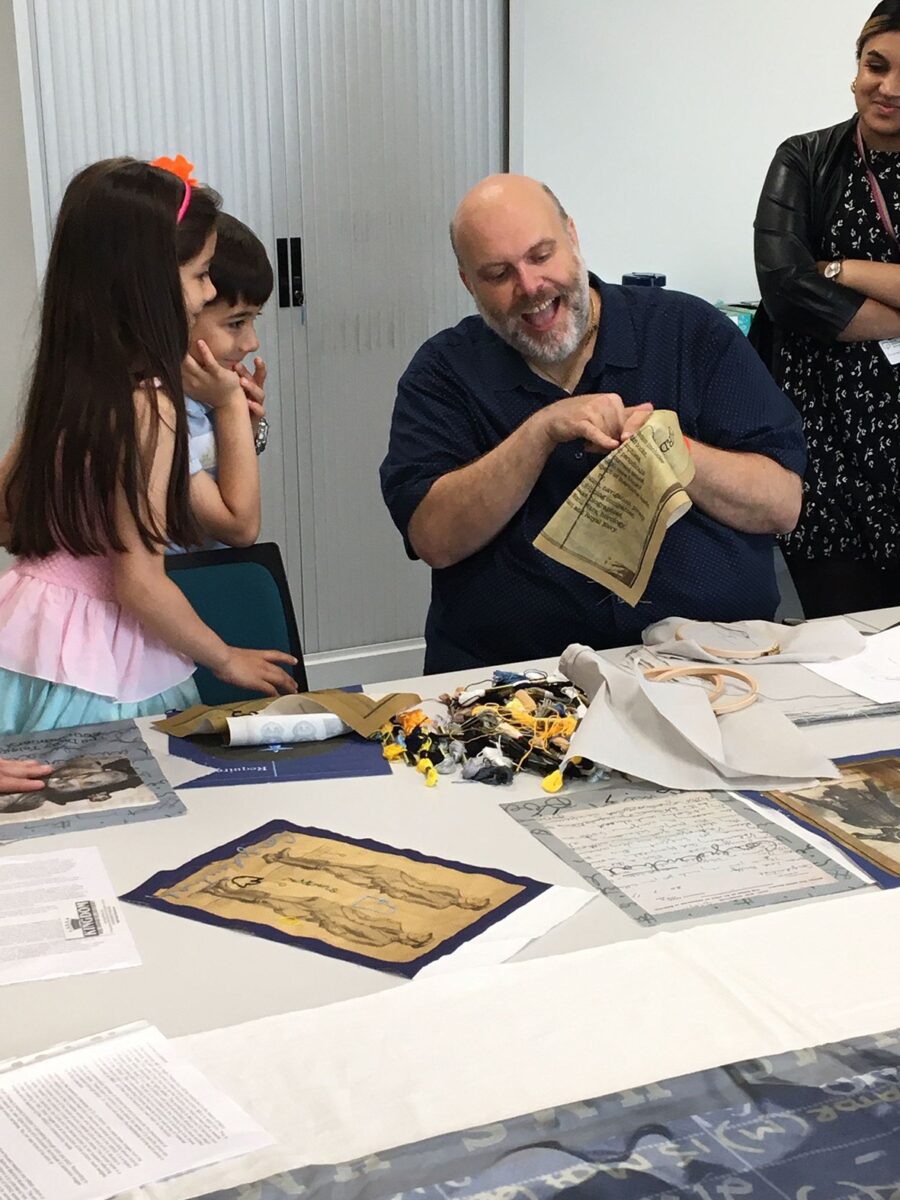
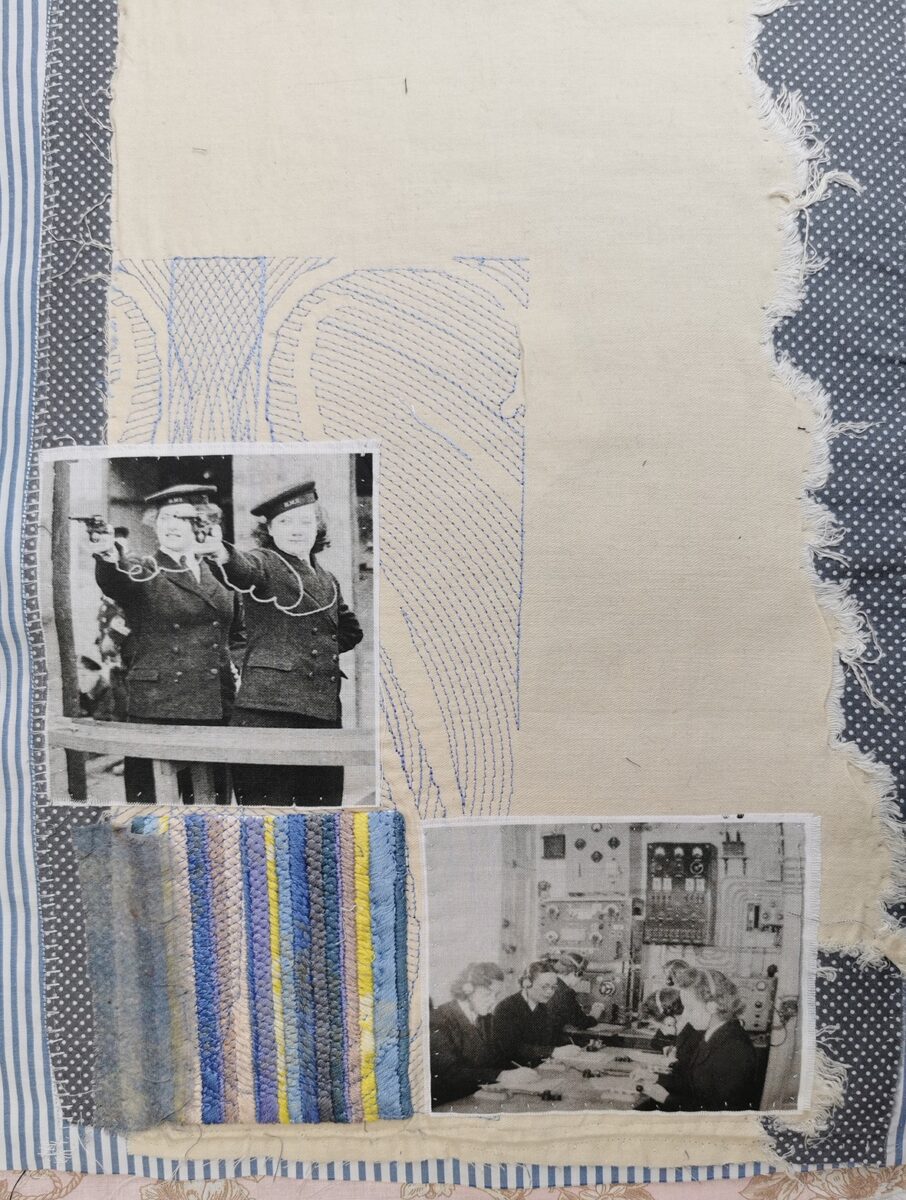
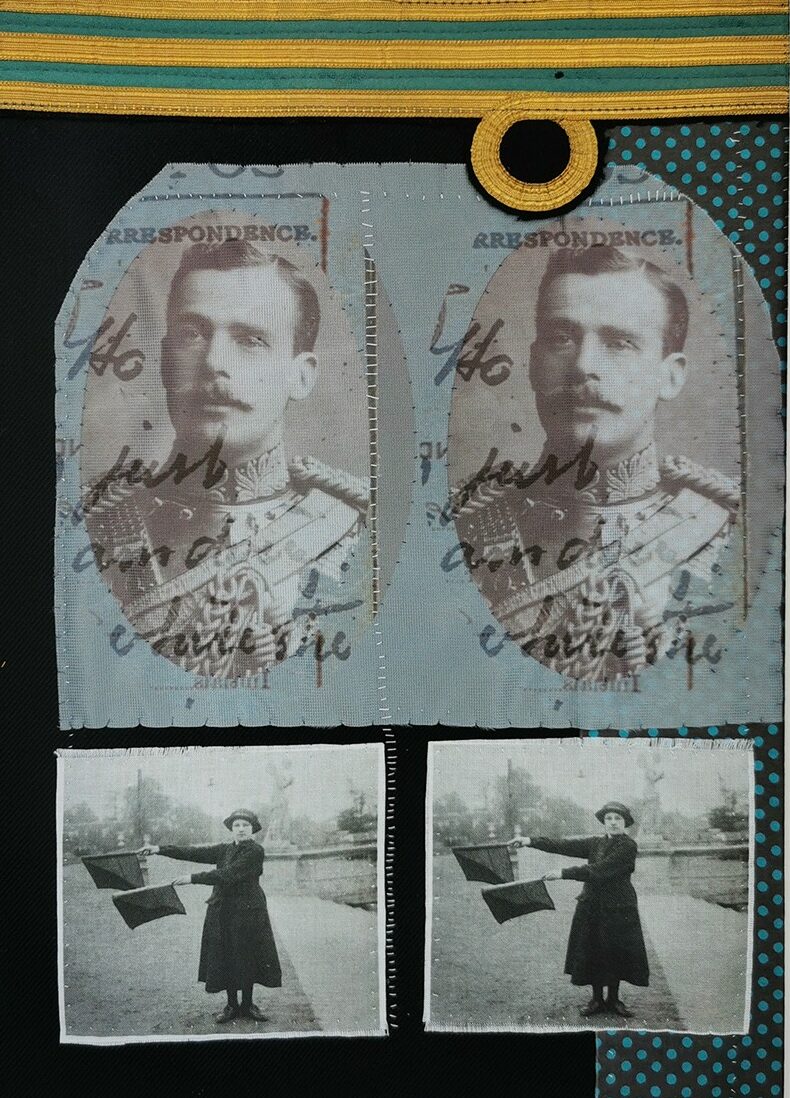
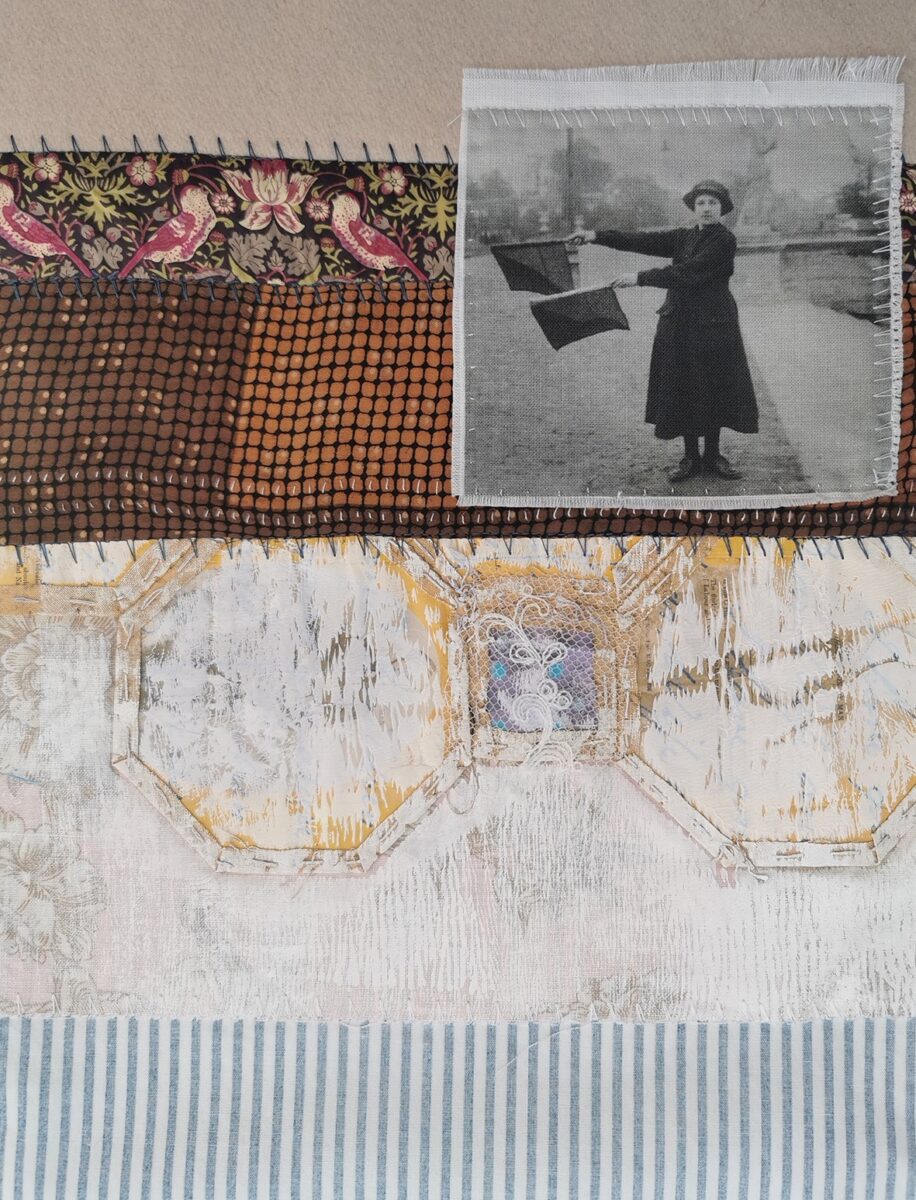
Nigel Cheney’s practice is founded in storytelling through cloth and stitch. Responding to archival material he uses digital printing and embroidery techniques to assemble images that create open ended narratives.Context: 'Dr Horton is conducting detailed material culture focused research into WRNS uniform of the early-mid twentieth century at the Caird Library, National Maritime Museum. The aim of this research, in the centenary year of the Association of Wrens is to understand how personal adaptation of uniforms may have influenced a) perception of WRNS appearance and b) uniform functionality in increasingly diverse and demanding roles for women during wartime, in the context of changing society and experiences. She is interrogating individual experiences of wearing uniforms during wartime, and how public, private, and personal-physical responses to uniform, may potentially have shaped the fashion and/or clothing identities of Wrens post- service, their ambitions, and attitudes, and ultimately the rest of their lives.
A part of this research is oral histories, so Dr Horton has invited contributions from individuals and/or their families to garner private perspectives on WRNS uniform (from dress to specialist workwear) worn by Wrens of different cultures, backgrounds, physicality, interests, and occupations. All types of WRNS uniform are relevant from officer and ratings uniforms (at home and overseas) and mess dress, to those associated with mechanical and outdoor roles such as overalls, boiler suits, bell-bottomed trousers, despatch riders and mail boat uniforms. 'Some fun facts about the WRNSThe Women's Royal Naval Service (WRNS; popularly and officially known as the Wrens) was the women's branch of the United Kingdom's Royal Navy. First formed in 1917 for the First World War, it was disbanded in 1919, then revived in 1939 at the beginning of the Second World War, remaining active until integrated into the Royal Navy in 1993. WRNS included cooks, clerks, wireless telegraphists, radar plotters, weapons analysts, range assessors, electricians and air mechanics.In 1915 orders were issued that ship's companies when ashore should wear the cap tally of their depot. In the Second World War, Royal Navy cap tallies were only issued with HMS, or HM Destroyer/Minesweepers. The Royal Canadian Navy ordered that only HMCS were to be worn their cap tallies in May 1942.Dame Katharine Furse was invited by the First Lord of the Admiralty to form a “Naval Organisation of Women.” Dame Katharine Furse, GBE, RRC (née Symonds; 23 November 1875 – 25 November 1952) was a British nursing and military administrator. She led the British Red Cross Voluntary Aid Detachment force during the First World War, and served as the inaugural Director of the Women's Royal Naval Service (1917–19). Furse was also the first Director of the World Association of Girl Guides and Girl Scouts (1928–38). Various names were discussed but the favourite was The Women’s Royal Naval Service and the name “Wrens” was approved.29 November 1917 HM The King approved the formation the Women’s Royal Naval Service to provide personnel wherever the Admiralty required them to serve. Mostly for domestic and clerical duties, but gradually WRNS Officers replaced paymasters, became secretaries to Admirals, and Wrens took over the duties of Writers, Telephonists, Stores and other shore based jobs, including places as far afield as Malta and Gibraltar. Gradually they took over other “male” jobs such as aircraft handlersWorld War One WRNS 438 officers, 5,054 ratings, 1+ death in service. 1918, RMS Leinster was torpedoed by a German Submarine. Three Wrens were onboard but only one lost her life – Wren Josephine Carr. The first Wren to lose her life in WWI and the only one to die as a result of enemy action.Locations: Mobile or immobile, serving at the chief naval bases in Portsmouth, Chatham, Devonport, London, Scotland, Ireland, Gibraltar, Genoa (Italy), Malta. Others included Cardiff, Harwich and the Humber, Liverpool and Tynemouth plus former naval air stations on the East Coast of Great Britain Service occupations: to support the war effort in anyway except ‘man’ a warship. Stores ratings, writers, dispatch riders and drivers, decoding and deciphering, secretarial, technical training, telephonists, wireless telegraphists, sailmakers, netmakers, painters, cleaners, woodturners, fitters, cooks, bakers, porters, garage workers, aircraft handlers and more. WRNS arm badges: Crossed quill pens- clerical and accountant; scallop shell-household; Three-spoked wheel-motor drivers and garage workers; Arrow crossed by a lightning flash-signal branch; Crossed keys-storekeepers, porters and messengers; Envelope- postwomen, telegraphists and postal workers, Star-miscellaneous, Crossed hammers- technical workersFrom 1939, Wren uniform, designed by leading British fashion designer Edward Molyneux, consisted of a double-breasted jacket and skirt, with shirt and tie, for all ranks (although similar working dress to the men could also be worn). Junior Ratings wore hats similar to those of their male counterparts (although with a more sloping top). Senior Ratings (Petty Officers and above) and officers wore tricornehats. In tropical areas with a white cover. All insignia, including cap badges and non-substantive (trade) badges, were blue. The tally on a sailor's cap is a ribbon usually bearing the name of a ship or some other establishment to which they belong.Mrs Vera Laughton Matthews was invited to become a Director of the WRNS. She had served in WWI and after the war was one of the pioneers of the Sea Ranger Branch of the Girl Guides. The early plan for the WRNS was to recruit 126 officers and 1,475 ratings.By the end of WWII over 74,000 women had served in over 70 categories.1981, The New Entry Training Establishment HMS DAUNTLESS closed after 35 years of training some 30,000 Wrens. Initial training now takes place alongside male ratings at HMS RALEIGH. Wrens were now subject to the Naval Discipline Act and given longer terms of service in a wide range of technical support roles in operational areas.1993, The Women’s Royal Naval Service was disbanded and 4535 women were integrated fully into the Royal Navy and able to serve on HM Ships at sea, at all ranks and rates, including the Royal Marines Band.Some quotes used in the textile piece“ We were not the demure young girls he had left behind when he set sail for Singapore. We had both seen and experienced too much to be treated as such delicate creatures still. He seemed to keep forgetting that I had been an Ensign and Pat was a Chief Petty Officer. We were grown women now. And grown women could drink whiskey when they felt like it”. (Owtram and Owtram, 2020).“ But for us ex-Wrens who had discovered independence and freedom, the world was our oyster” ( Lamb, I only joined for the hat, Redoubtable Wrens at war..their trials, tribulations and triumphs, 2007).“Joy recalled seeing a line of girls linked who danced out of the mess singing “wish us luck as you wave us goodbye” and they never came back as they were killed in service. ( Platt, oral histories 2022)‘The biggest bombshell was, naturally, the arrival on 11th June, 1941 of Wren Joy Cullis’( Platt, oral histories 2022)Moyra Charlton : “Work filled one’s life, but I would not have missed it for anything” p.21. Darmouth History Research Group Paper 12 1994 ISBN 1 899011013Wren Hazel Hyam, quartered at Warfleet said“ In my spare time I did a lot of embroidery and needlework, making camiknicks, pretty slips for Mother’s birthday, and nighties. Clothing vouchers were usually requested for pyjamas, but we could go along to a certain shop in Torquay and buy material instead. I embroidered a cushion in a WRNS crest design for my parents, and now have in constant use. Some girls autographed each other’s white scarves and then embroidered their signatures, making a lasting memory.”p. 25. Darmouth History Research Group Paper 12 1994 ISBN 1 899011013 Moyra Charlton : “Work filled one’s life, but I would not have missed it for anything” Darmouth History Research Group Paper 12. P.21 1994 ISBN 1 899011013We were grown women now. And grown women could drink whiskey when they felt like it”. (Owtram and Owtram, Codebreaking Sisters Our Secret War, 2020 p. 250). “ But for us ex-Wrens who had discovered independence and freedom, the world was our oyster” ( Lamb, I only joined for the hat, Redoubtable Wrens at war..their trials, tribulations and triumphs, 2007, p.196). “Joy recalled seeing a line of girls linked who danced out of the mess singing “wish us luck as you wave us goodbye” and they never came back as they were killed in service. (Platt, oral histories interview 16th March, 2022)Wren Gwyneth Verdon-Roe “ The night of the 4/5th June, I was on all night. We worked flat out until dawn and then the whole thing was called off because of the weather. The disappointment was terrible, the anti-climax after all the stress. We were tearful and tired and had never felt so low in all our lives” (Harris, D-Day Diary, Life on the Front Line in the Second World War, 2013 p.48. “ And below is another W.R.N.S - this time an Indian- Second Officer Sen. A charming combination of East and West, we think” . (Women’s Pictorial)The W.R.I.N.S or the Women’s Royal Indian Naval Service was formally set up in January 1944 as the naval wing of the Women’s Auxiliary Corps (India) in response to the increasing demand for labour to fill up “shore jobs” during the Second World War. Nearly three decades after the formation of their counterpart, the Women’s Royal Naval Service or the WRENS, the WRINS became a symbol of a new India, subverting gender norms and laying the steppingstone for a new, independent India and an emancipated Indian woman.“In a beautiful piece of tapestry a vast number of threads of varying colours combine to produce the finished picture. All threads are of equal strength; all colour are equally necessary to the pattern though some may be more obtrusive. It is for this reason that I have chosen the name of “Blue Tapestry” for this story of the Women’s Royal Naval Service” ( Laughton Matthews, 1949, p. 10)“ Dedicated to Ex-Leading Wren Elvira Laughton Matthews. Not only as my beloved daughter but as a symbol of the women who, with devotion, fidelity and diverse offerings, combined to weave the BLUE TAPESTRY”. ( Laughton Matthews, 1949).